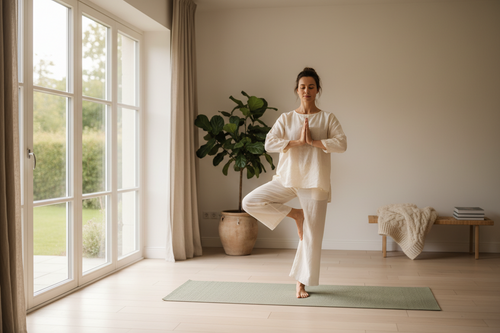
We are strangely diligent about training the body and strangely casual about training the mind. We'll follow a plan to the decimal — sets, splits, paces, rest — and then leave the most decisive part of performance, the part happening between our ears, almost entirely to chance.
The part we leave to chance
Ask most people how they want to feel under pressure and they'll have an answer. Ask them how they practise it, and the room goes quiet. We tend to treat mindset as something you either have or you don't — a fixed trait, a bit of luck on the day. But attention, composure, and the story you tell yourself when it starts to hurt behave far more like skills than like weather. And skills respond to practice.
Reflection is a skill, not a mood
Psychology has a slightly clinical word for the thing underneath all of this: metacognition — thinking about your own thinking. It sounds abstract until you notice how much of sport is exactly that. Noticing you've tightened up. Catching the thought that says here we go again. Choosing, in the half-second you have, to do something other than the automatic thing.
You can't manage what you can't see. Reflection is how you learn to see it.
What the page does
Writing is one of the oldest tools we have for this, and it works for reasons that are almost mechanical:
- It externalises. A worry looping in your head feels enormous; the same worry written in a sentence is just a sentence — and usually a smaller one than it felt.
- It slows you down. You can't write as fast as you can spiral. The pace of the pen forces a gap between the feeling and the conclusion.
- It closes the loop. Training without reflection is just repetition. A few lines afterwards turn an experience into something you can actually learn from.
- It reveals patterns. Any single entry is a snapshot. Twenty of them, read back, show you the things you'd never catch day to day — the situations that rattle you, and the ones that bring out your best.
The space it buys you
There's a well-worn idea that between what happens to us and how we respond there is a space — and that our growth lives in that space. Whether or not you buy the philosophy, anyone who has competed knows the space is real, and knows how quickly it can vanish. Reflection is, in a sense, training for that gap: the more familiar you are with your own patterns off the field, the more room you have to choose on it.
How to start: five honest minutes
You don't need a system. You need a few honest minutes, ideally at the same two moments each day.
Before — one line: What matters today, and how do I want to show up for it?
After — three questions:
- What actually happened — not the highlight reel, the real version?
- What was I telling myself while it happened?
- What's one thing worth keeping, and one thing worth trying differently?
That's it. The value isn't in writing beautifully. It's in the noticing, repeated.
Not a diary — a practice
This is the whole idea behind what we make: not a diary, and not a motivational poster, but a structured place to do this small, unglamorous, genuinely useful work — built around how you actually train. I'm still learning it myself, in my own training and in coaching, and a lot of what I read I end up rewriting here, in plainer terms, so it's easier to use than to admire.
Start with five minutes. Write it down. See what you notice.